As parents, we all want the same thing: to prepare our children for a future that is rapidly changing.
For decades, the formula seemed straightforward. Work hard, get good grades, earn a degree, and secure a stable career. But today, that formula is being challenged by something that is transforming every industry at an unprecedented pace — Artificial Intelligence (AI).
Singapore is positioning itself as one of the world’s leading AI-powered economies. The government is investing heavily in AI adoption across education, healthcare, finance, logistics, manufacturing, public services, and countless other sectors. Businesses are actively seeking ways to automate routine work, increase efficiency, and reduce costs.
This raises an important question for parents:
If AI can perform many academic and technical tasks better and faster than humans, what skills will make our children valuable in the future?
The answer may surprise many parents.
The Future Belongs to Those Who Can Communicate
AI can generate reports.
AI can analyse data.
AI can write code.
AI can answer questions.
AI can even create presentations.
But AI cannot truly replace the uniquely human ability to connect, persuade, inspire, negotiate, empathise, lead, and build trust.
The future workforce will not simply be divided between those who are academically strong and those who are not.
Instead, it will increasingly be divided between those who can effectively communicate with people and those who cannot.
As AI takes over routine tasks, human interaction becomes even more valuable.
Employers will continue to need people who can:
- Present ideas clearly
- Lead teams
- Build relationships
- Influence decisions
- Negotiate outcomes
- Think critically
- Ask intelligent questions
- Adapt to new situations
- Solve complex problems involving people
These are not skills that can be memorised for an examination.
They are skills that must be developed over time through practice, feedback, and real-world communication experiences.
Why English Proficiency Matters More Than Ever
Many parents assume that because AI can now write essays and generate answers, language skills will become less important.
The opposite is true.
AI is fundamentally a language technology.
The people who benefit most from AI will be those who can communicate effectively with it.
To use AI well, students must be able to:
- Read critically
- Analyse information
- Ask precise questions
- Evaluate responses
- Express ideas clearly
- Detect inaccuracies
- Make informed decisions
In other words, strong English language skills become even more important in an AI-powered world.
A student who struggles to communicate clearly will struggle to leverage AI effectively.
A student with strong language, reasoning, and communication skills will be able to use AI as a powerful tool to multiply their capabilities.
The future will not belong to those who simply use AI.
It will belong to those who can think, question, communicate, and lead while using AI.
The Industries That Will Continue to Need Strong Communicators
Many jobs will evolve significantly because of AI.
However, industries that rely heavily on human interaction will continue to value communication skills as one of their most important assets.
These include:
Education
Teachers, trainers, coaches, and educators must inspire, motivate, and guide learners. Human connection remains at the heart of learning.
Healthcare
Doctors, nurses, therapists, psychologists, and healthcare professionals need empathy, trust-building, and effective communication with patients and families.
Law
Lawyers must persuade, negotiate, advocate, and explain complex issues clearly.
Business Leadership
Managers, entrepreneurs, executives, and team leaders need to influence people, build consensus, and drive organisational change.
Sales and Client Management
Customers buy from people they trust. Relationship-building remains a fundamentally human skill.
Government and Public Service
Policymakers, diplomats, community leaders, and public servants must engage citizens, manage stakeholders, and communicate effectively.
Media and Content Creation
While AI can generate content, humans continue to provide judgement, storytelling, authenticity, and emotional connection.
Consulting and Advisory Roles
Clients seek trusted advisors who can understand complex situations and communicate recommendations effectively.
In many of these professions, communication may become even more valuable as technical tasks become increasingly automated.
The Growing Risk of Being Left Behind
Singapore’s education system has traditionally placed significant emphasis on academic achievement.
Academic excellence will always matter.
However, in a future where AI can perform many knowledge-based tasks instantly, academic qualifications alone may no longer be sufficient to differentiate an individual.
Two students may possess similar academic results.
The student who can confidently present ideas, engage an audience, lead discussions, think critically, and communicate persuasively will have a significant advantage.
This is where many parents may face a difficult reality.
Communication skills are not developed overnight.
They cannot be crammed for just before a job interview or university admission exercise.
Like learning a musical instrument or a sport, communication skills require years of consistent development.
Parents who wait until their children are older may discover that others have already built a considerable advantage.
Why Trinity College London Communication Skills Matters
One of the most effective ways to prepare children for this future is through structured communication skills training.
The Trinity College London Communication Skills programme provides students with opportunities to develop skills that remain highly relevant in an AI-driven world.
Students learn to:
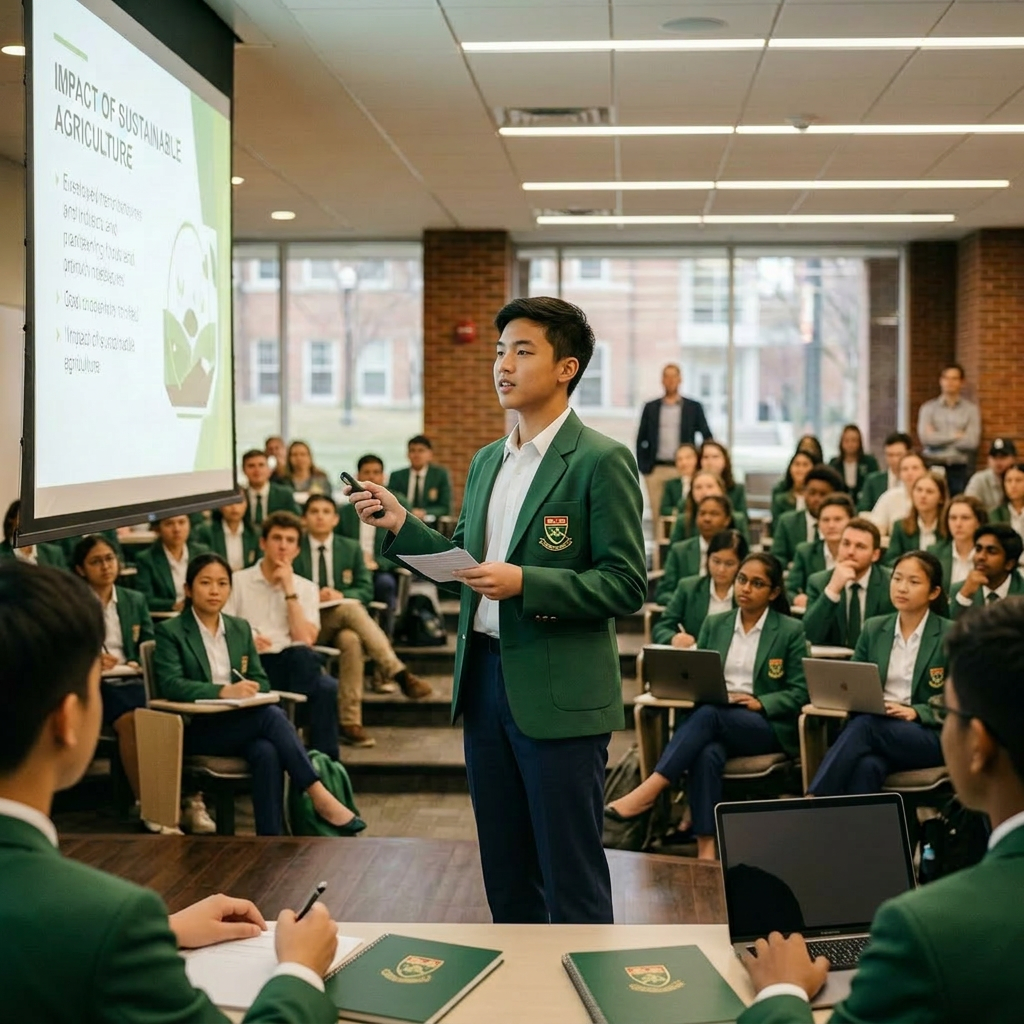
- Speak confidently before an audience
- Organise and present ideas clearly
- Engage listeners effectively
- Think critically and independently
- Respond thoughtfully to questions
- Conduct research
- Analyse information
- Build persuasive arguments
- Communicate with confidence and clarity
Importantly, these are not merely examination skills.
They are life skills.
The programme encourages students to become articulate thinkers, effective communicators, and confident individuals who can express themselves clearly in both academic and professional settings.
Preparing Children for a Future That Does Not Yet Exist
Perhaps the greatest challenge facing parents today is that many of the jobs our children will eventually hold have not even been created yet.
The technologies they will use may not yet exist.
The industries they work in may look completely different from those of today.
While we cannot predict every change, we can identify the skills that remain timeless.
The ability to communicate.
The ability to think critically.
The ability to analyse information.
The ability to lead.
The ability to persuade.
The ability to connect with other human beings.
These skills have always mattered.
In the age of AI, they may become the very skills that separate those who thrive from those who struggle to remain relevant.
As parents, perhaps the question is no longer whether our children should develop communication skills.
The real question is whether we can afford to delay helping them develop these skills while the world around us changes faster than ever before.
Because in a future where AI can do many things, being deeply and effectively human may become our children’s greatest competitive advantage.
Authored by Jackeline Carter, Founder of J Carter Centre for Public Speaking
Prepare Your Child for an AI-Powered Future
The earlier children develop these skills, the better prepared they will be for the future.
Our next Trinity College London Communication Skills classes at J Carter Centre begin at the end of June.
WhatsApp 97320207 today to learn how your child can gain the communication skills needed to thrive in a world shaped by AI.